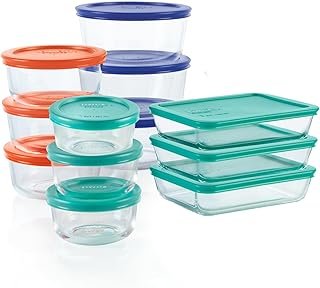
Glass food storage containers are a non-toxic, long-lasting alternative to plastic for storing leftovers, prepped ingredients, and pantry staples. Understanding the differences between options helps you build a storage system that serves your kitchen well.
Why Glass Over Plastic
Glass food storage offers several advantages over plastic: it does not absorb stains or odors from strongly flavored foods; it does not leach chemicals into food; it goes safely from refrigerator to microwave to oven to dishwasher; it is essentially permanent — quality glass containers last decades. The main trade-offs are weight and the risk of breakage if dropped.
Types of Glass
Tempered Glass
Tempered glass is the standard for food storage containers. It is significantly stronger than regular glass — approximately 4-5 times more impact resistant — and when it does break, it shatters into small, less dangerous pieces rather than sharp shards. Pyrex uses tempered glass throughout their storage line. Tempered glass handles thermal transitions (refrigerator to microwave or oven) without cracking under most normal conditions.
Borosilicate Glass
Borosilicate glass has greater thermal shock resistance than standard tempered glass — it can go from freezer to oven more safely. It is used in some premium food storage brands (Glasslock, some OXO Glass lines). More expensive than standard tempered glass but more durable under extreme temperature transitions.
Lid Materials and Seal Quality
Most glass containers use plastic or silicone lids. The lid creates the seal — its quality determines how airtight the container is. Snap-lock lids with silicone gaskets provide the best seal for liquid-containing foods. Screw-top lids provide a reliable seal for most dry and semi-dry foods. Simple press-on lids seal less reliably and are better for short-term refrigerator storage of foods that do not need to be completely airtight.
Oven Safety
Most tempered glass containers are oven safe to 220-230°C (430-450°F) without the lid. Check the specific container rating. Lids (particularly plastic lids) are not oven safe — always remove the lid before putting the container in the oven. Some containers can go directly from fridge to a preheated oven — check the thermal shock rating of the specific product before doing this.
Set Composition
Glass food storage sets typically include a range of sizes from small (1-2 cup) to large (4-10 cup). Common set compositions include 3, 5, or 10 pieces. A varied set covering small, medium, and large containers handles the widest range of storage needs. Consider whether the set includes rectangular containers (which stack and store more efficiently) as well as round ones (which are more practical for round foods).
Stackability and Storage
Flat-bottomed, straight-sided rectangular containers with matching lid profiles stack much more efficiently in a refrigerator or cabinet than round or irregular shapes. Sets designed for stackability — where containers of different sizes nest inside each other when empty — minimize storage space needed.
What to Look For
For most households, a 10-piece Pyrex or OXO glass food storage set with snap-lock airtight lids, in a mix of rectangular sizes from 1 to 4 cups, is the most practical investment. Look for oven-safe glass bodies, snap-lock lids with silicone gaskets, and dishwasher compatibility on both glass and lids.
Summary
Glass food storage containers are a durable, non-toxic, and versatile kitchen storage system. Tempered glass construction, lid seal quality, thermal ratings, and stackable design are the key factors. A quality glass set is a long-term investment that replaces and outlasts multiple generations of plastic containers.
You can check more details and current options on Amazon here.