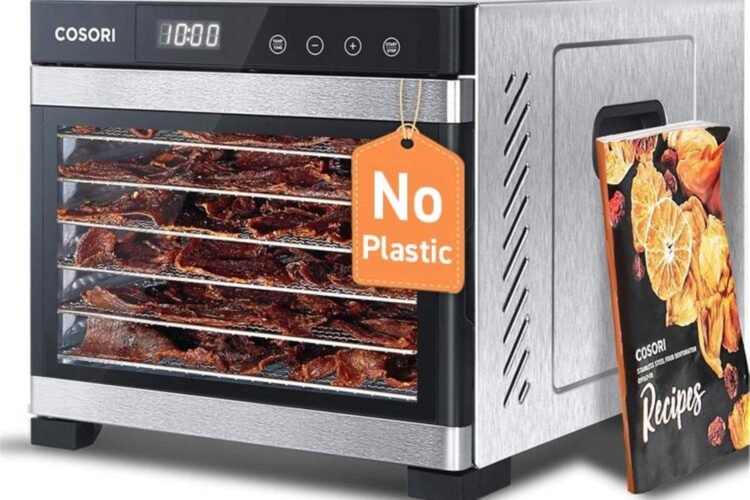
A food dehydrator removes moisture from food through sustained low heat and airflow, preserving it for significantly longer than fresh storage. It is a practical appliance for home cooks who want to make jerky, dried fruits, vegetable chips, and herbs — or who want to reduce food waste by preserving excess produce.
How Food Dehydration Works
Dehydration inhibits the growth of bacteria, mold, and yeast by removing the moisture they need to survive. A food dehydrator circulates warm air (typically at 35-75°C / 95-165°F) over food on mesh trays. Lower temperatures preserve nutrients and flavor in fruits and herbs; higher temperatures are required for safe dehydration of meat (jerky).
Types of Food Dehydrators
Stackable Tray Dehydrators
The entry-level design — circular trays that stack vertically with a motor and heating element at the top or bottom. They are compact and affordable. The main limitation is that the heat distribution can be uneven — trays closest to the heating element dry faster than those furthest away, requiring tray rotation during longer dehydration sessions. Good for occasional use.
Box/Shelf Dehydrators
A box-shaped unit with multiple shelf trays and rear-mounted heating element and fan. The rear-mounted airflow provides more even heat distribution than top/bottom-mounted designs. More expensive, takes up more counter space, but produces more consistent results and usually has greater capacity. Cosori and Excalibur make popular models in this category.
Key Specifications
Temperature Range and Control
A temperature range of 35-75°C (95-165°F) covers all standard dehydration applications. A digital thermostat with precise control produces more consistent results than analog dial controls. USDA guidelines require meat for jerky to reach 71°C (160°F) for food safety — verify your machine can reliably maintain this temperature.
Timer
A built-in timer that automatically shuts off the dehydrator at the end of the cycle is a practical safety feature for long dehydration sessions (jerky can take 4-10 hours). Without a timer, you must manually check and shut off the unit.
Tray Material
Stainless steel mesh trays are the most durable and easiest to clean. Plastic mesh trays are fine for most foods but can absorb strong odors. BPA-free plastic is the minimum standard for plastic trays.
Capacity
More trays mean more food can be dehydrated in a single session. For most home use, 5-6 trays is adequate. If you regularly dehydrate large batches of fruit or garden produce, a larger capacity unit (8-10 trays) is more practical.
Common Dehydration Applications
Beef and turkey jerky; dried fruit (apple slices, mango, apricots, strawberries); vegetable chips (kale, beet, zucchini); sun-dried tomatoes; dried herbs (basil, oregano, parsley); trail mix ingredients; banana chips; dried mushrooms; rehydratable camping/backpacking food.
What to Look For
For most home cooks, a box-style dehydrator with stainless steel trays, digital temperature control, a built-in timer, and a capacity of 5-6 trays is the best choice. Cosori makes well-regarded mid-range dehydrators that cover most home applications with good temperature consistency and easy cleanup.
Summary
A food dehydrator is a practical appliance for making jerky, dried fruit, vegetable chips, and preserved herbs at home. Box-style units with rear-mounted fans produce more even results than stackable designs. Temperature control, timer, and tray material are the most important specifications.
You can check more details and current options on Amazon here.